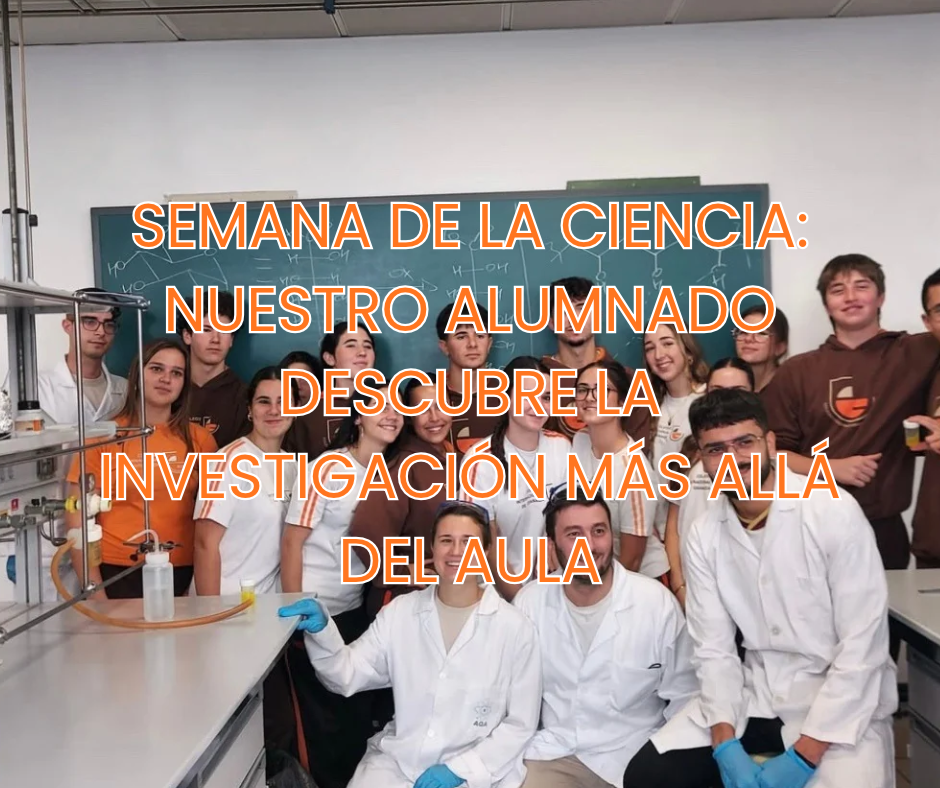
Science has taken center stage in a very special educational experience for the students of Colegio Internacional de Granada. To mark Science Week, students in 3rd and 4th year of ESO (Compulsory Secondary Education) and 1st year of Bachillerato (Upper Secondary Education) took part in various activities that allowed them to engage with scientific knowledge outside the usual classroom environment.
Through visits, talks, and hands-on experiences, our students had the opportunity to discover different fields of research, ranging from marine geology and climate studies to eclipses, organic chemistry, and microorganisms.
1. A Science Week for learning in a different way
Science Week is an opportunity to bring scientific knowledge closer to students and spark their interest in understanding the world around them. On this occasion, students in 3rd and 4th year of ESO and 1st year of Bachillerato at Colegio Internacional de Granada stepped outside the classroom to take part in activities related to various scientific disciplines. Researching, experimenting, and discovering took center stage in these experiences, allowing students to approach scientific content from a different perspective. These types of initiatives complement academic learning and provide insight into some of the spaces where research takes place.
2. ESO students visit the IACT-CSIC
Students in 3rd and 4th year of Compulsory Secondary Education visited the IACT-CSIC, the Andalusian Institute of Earth Sciences, which is affiliated with the Spanish National Research Council (CSIC) and the University of Granada. During the visit, students participated in talks and hands-on workshops related to different areas of Earth sciences. This experience allowed them to explore topics connected to marine geology, minerals, and climate studies. Learning about these fields of research helps students better understand the natural processes occurring on our planet and the importance of studying them from a scientific perspective.
3. Discovering marine geology and minerals
One of the areas covered during the visit to the IACT-CSIC was marine geology, a discipline dedicated to studying the ocean floor, its materials, and the geological processes that occur beneath the sea. Students were also introduced to the world of minerals, which are fundamental components of many of the rocks that make up our planet. Through talks and practical workshops, ESO students had the opportunity to gain a deeper understanding of these research areas. Understanding the Earth’s composition and processes makes it possible to interpret natural phenomena that are part of our environment, from the formation of rocks to the evolution of landscapes.
4. The importance of climate research
Climate study was another topic featured in the activities held during the visit to the Andalusian Institute of Earth Sciences. Climate research makes it possible to analyze atmospheric conditions over time and understand the factors that influence their variations. It is a particularly relevant scientific field for studying the changes our planet is undergoing. During Science Week, 3rd and 4th year ESO students were able to explore this discipline through the activities scheduled at the IACT-CSIC. Introducing young people to climate research can help them grasp the importance of scientific knowledge in interpreting today’s environmental challenges.
5. Bachillerato students discover science at the University of Granada
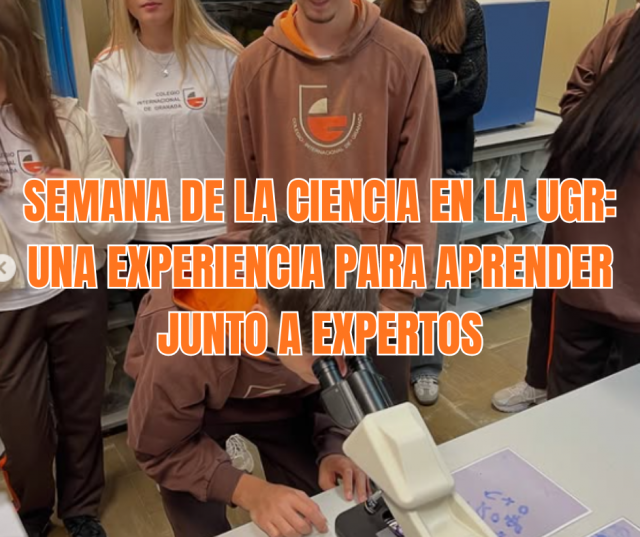
Meanwhile, 1st year Bachillerato students visited the Faculty of Sciences at the University of Granada, where they had the opportunity to expand their knowledge across different scientific disciplines. During this experience, students learned about eclipses, organic chemistry, and the world of microorganisms. The visit allowed them to engage with topics related to astronomy, chemistry, and biology within a university setting. Getting to know spaces dedicated to higher education and scientific research can spark new academic interests and help students discover fields of knowledge that might appeal to them in the future.
6. Eclipses, organic chemistry, and microorganisms
The 1st year Bachillerato activities covered three very different scientific fields. Eclipses offered a look into astronomical phenomena that occur when certain celestial bodies align and one completely or partially obscures another. Organic chemistry, on the other hand, studies carbon compounds and their properties—a field with numerous applications in our daily lives. Finally, students explored aspects related to microorganisms, microscopic beings present in a wide variety of environments. These three fields demonstrate how science studies phenomena on vastly different scales, from the movements of celestial bodies to organisms invisible to the naked eye.
7. Learning science outside the classroom
Visits to research centers and university facilities can provide educational opportunities that complement the material covered in class. They bring students closer to different disciplines, familiarize them with research environments, and reveal new perspectives on scientific knowledge. During this Science Week, students at Colegio Internacional de Granada were able to take part in experiences that connect academic learning with real-world research environments. For those looking for a bilingual high school in Granada, learning about the educational activities that complement Secondary and Bachillerato education can be a key factor when evaluating an educational project.
8. An experience to keep sparking scientific curiosity
Science Week has allowed our 3rd and 4th year ESO and 1st year Bachillerato students to engage with various areas of scientific knowledge through their visits to the IACT-CSIC and the Faculty of Sciences at the University of Granada. From marine geology and climate studies to eclipses, organic chemistry, and microorganisms, each experience has offered an opportunity to discover new perspectives on the world around us. At our school in Granada, we value the importance of bringing students closer to science and fostering their curiosity to understand natural phenomena.
Because science isn’t just studied… it’s experienced!