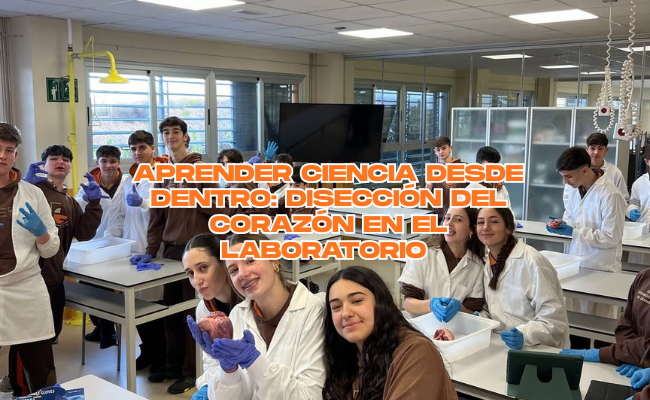
At our International School of Granada, we understand that learning Biology must go beyond the textbook, allowing students to experiment and analyze reality in a practical way. Therefore, as part of the unit on the circulatory and excretory systems, the students performed a dissection of a pig’s heart after having previously studied the anatomy and physiology of the human heart.
A theoretical foundation before the practical experience
Before beginning the activity, students worked in class on the fundamental concepts related to the functioning of the circulatory system. This prior work was key to ensuring a solid understanding of the content, as it allowed the practical session to be carried out with purpose rather than as a simple, isolated observation.
Group work as part of learning
The lab session was developed in groups, which favored cooperation, dialogue, and the exchange of ideas. In our school in Granada, we consider cooperative learning fundamental, as it helps students learn from one another and develop social skills linked to the scientific field.
Observation of external anatomy
The first step of the activity consisted of observing the external anatomy of the heart, identifying its shape, size, and general structure. This moment allowed students to begin relating theoretical diagrams to a real organ, encouraging detailed scientific observation.
Guided and responsible dissection
Next, the students learned how to perform the dissection in a guided manner, following the teachers’ instructions. This process involved respect for the materials, attention to instructions, and a responsible attitude toward laboratory work—essential aspects for developing a rigorous scientific culture.
Identification of internal structures
During the dissection, students were able to identify the main parts of the heart: atria, ventricles, valves, arteries, and veins. This moment was especially relevant, as it allowed for a better understanding of the specific function of each structure and its role within the circulatory system.
Understanding the functioning of the human body
Seeing the real organ helped students understand how blood circulates, how the cavities are separated, and how the valves work. This experience facilitated a deeper and more visual understanding of how the human body functions.
Connecting theory and reality
the lab session allowed for the merging of what was studied in class with direct experience, reinforcing meaningful learning. In our school in Granada, we advocate for these types of activities because they help the content settle in a more lasting and comprehensible way.
Developing scientific thinking
Beyond the curricular content, this practice encouraged the formulation of questions, critical observation, and the interpretation of what was observed. These skills are key to developing scientific thinking and the intellectual curiosity of the students.
An experience that leaves a mark
In our bilingual institute in Granada, we believe that learning science from the inside—by observing and analyzing—generates a very positive impact on the students. These types of activities not only reinforce knowledge but also spark an interest in Biology and the functioning of one’s own body.