Science is also discovered through experience
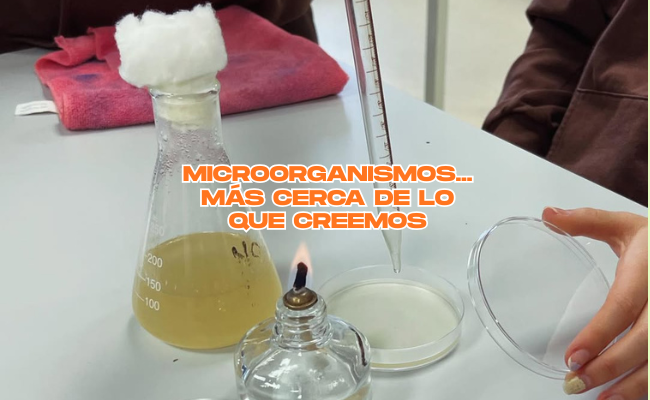
At our Colegio Internacional de Granada, we believe that scientific learning is much more meaningful when students can experience it directly. For this reason, 1st-year Bachillerato students have carried out a microbiology laboratory practical to investigate where the microorganisms that surround us in our daily lives are located.
A real approach to the microscopic world
During the activity, students took samples from different everyday objects and various parts of the body with the aim of observing the presence of microorganisms. This process made it possible to understand that bacteria and fungi are a constant part of our environment, something that often goes unnoticed in daily life. At our school in Granada, we encourage these types of experiences because they help connect theory with scientific reality.
Practical work with laboratory techniques
Throughout the practical, students prepared their own Petri dishes and cultured the collected samples. This process involved following a series of organized steps, applying safety regulations, and working with precision. At our institute in Granada, these activities allow students to develop scientific rigor and responsibility in the laboratory.
Learning the fundamentals of microbiology
The practice included the use of basic techniques such as the preparation of culture media, working under sterile conditions, and the isolation of colonies. These methodologies are fundamental in the study of microorganisms and constitute an important basis for understanding how bacteria and fungi are researched in real scientific settings.
Observing results and drawing conclusions
After preparing the plates and allowing the microorganisms to grow under appropriate conditions, the students were able to observe the development of microbial colonies. This moment allowed them to analyze the results obtained and reflect on the presence of microorganisms on apparently clean surfaces. The activity reinforced the capacity for observation and scientific analysis.
A way of learning that sparks curiosity
Laboratory practicals allow students to become actively involved in the learning process. At our bilingual school in Granada, we aim for students not only to memorize concepts but to understand how scientific knowledge is generated through experimentation.
Developing scientific thinking
Microbiology requires precision, method, and the ability to interpret. By working with real samples, students understand that science is based on observation, data recording, and the analysis of results. This type of experience strengthens critical thinking and investigative curiosity.
Preparation for future scientific studies
Activities like this introduce students to procedures used in professional and university laboratories. As a bilingual institute in Granada, we consider it important for students to know the workings of a scientific laboratory and the value of the experimental method starting from Bachillerato.
Learning science by living it
Microbiology stops being an abstract concept when it is observed directly in a Petri dish. Seeing the growth of bacteria and fungi allows for a better understanding of the importance of hygiene, research, and the study of microorganisms in science.
Science makes sense when it is experienced
At the Colegio Internacional de Granada, we continue to commit to an education where students investigate, observe, and experiment. Because understanding science is much easier when it is experienced from within the laboratory.