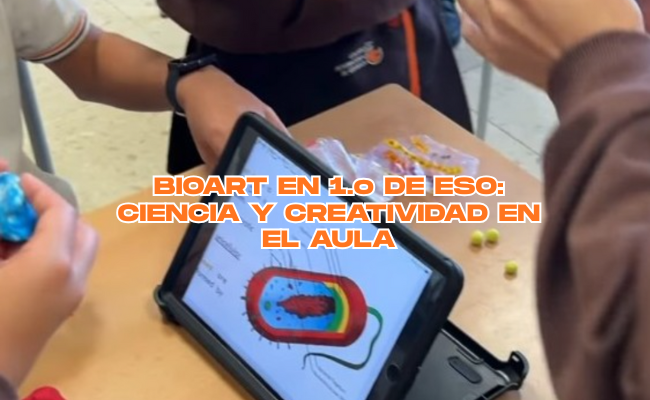
At our International School in Granada, we are committed to active methodologies that allow students to learn in a meaningful and participatory way. Within this framework, our 1st Year ESO (7th Grade) students developed the project “BioArt: Sculpting the Cell.” This educational initiative combined the study of biology with creativity and manual work, making complex concepts easier to understand through a visual and practical approach.
Before starting the project, students worked in class on different types of cellular organization, analyzing their parts and main characteristics. This prior work was essential to ensure a solid understanding of the content, allowing the practical activity to be supported by well-established knowledge.
To carry out BioArt, students were organized into five workgroups, fostering collaboration, communication, and shared responsibility. Each group chose a different cell type, which allowed the unit to be approached from multiple perspectives and enriched the collective learning experience.
The representation of the cells was done using modeling clay, a material that facilitated the sculpting of cellular structures. This hands-on methodology encouraged visual and experiential learning, helping students better identify the different parts of the cell and their arrangement.
The project served as the final activity of the unit, consolidating the content covered previously. Learning science in this way increased student engagement, proving that creating and experimenting are also fundamental parts of scientific learning.
Beyond the academic curriculum, BioArt allowed students to practice skills such as planning, time management, and group decision-making. At our school in Granada, we believe it is vital for students to develop competencies that go beyond theoretical knowledge.
Representing cells in three dimensions helped reinforce the understanding of abstract concepts. This type of learning facilitates information retention and is especially effective in the early stages of Secondary education.
One of the most notable aspects was the students’ attitude during the project. The opportunity to experiment, make mistakes, and correct them fostered a positive learning experience where the process was valued as much as the final result.
The final result was fantastic and reflected the hard work, involvement, and creativity of all the groups. At our school in Granada, we especially value these types of projects that allow students to showcase what they have learned in a unique way.
At our bilingual institute in Granada, we will continue to promote initiatives like BioArt, where science is learned through creation. This project has shown that when learning is lived through experience, interest in the subject grows and knowledge is consolidated for the long term.